 By Editorial Team
Q2 2026 Regulatory Intelligence raises critical questions about the durability of investments in healthcare AI, and what truly separates lasting value from ephemeral market hype. For policymakers grappling with safe and effective innovation, and for investors meticulously vetting opportunities, understanding the evolving regulatory landscape is paramount. The FDA’s Predetermined Change Control Plan (PCCP) guidance, in particular, signals a pivotal shift, offering a glimpse into how continuous learning AI will be governed, and which companies are best positioned to thrive.
The FDA’s PCCP: Adapting Regulation to Adaptive AI
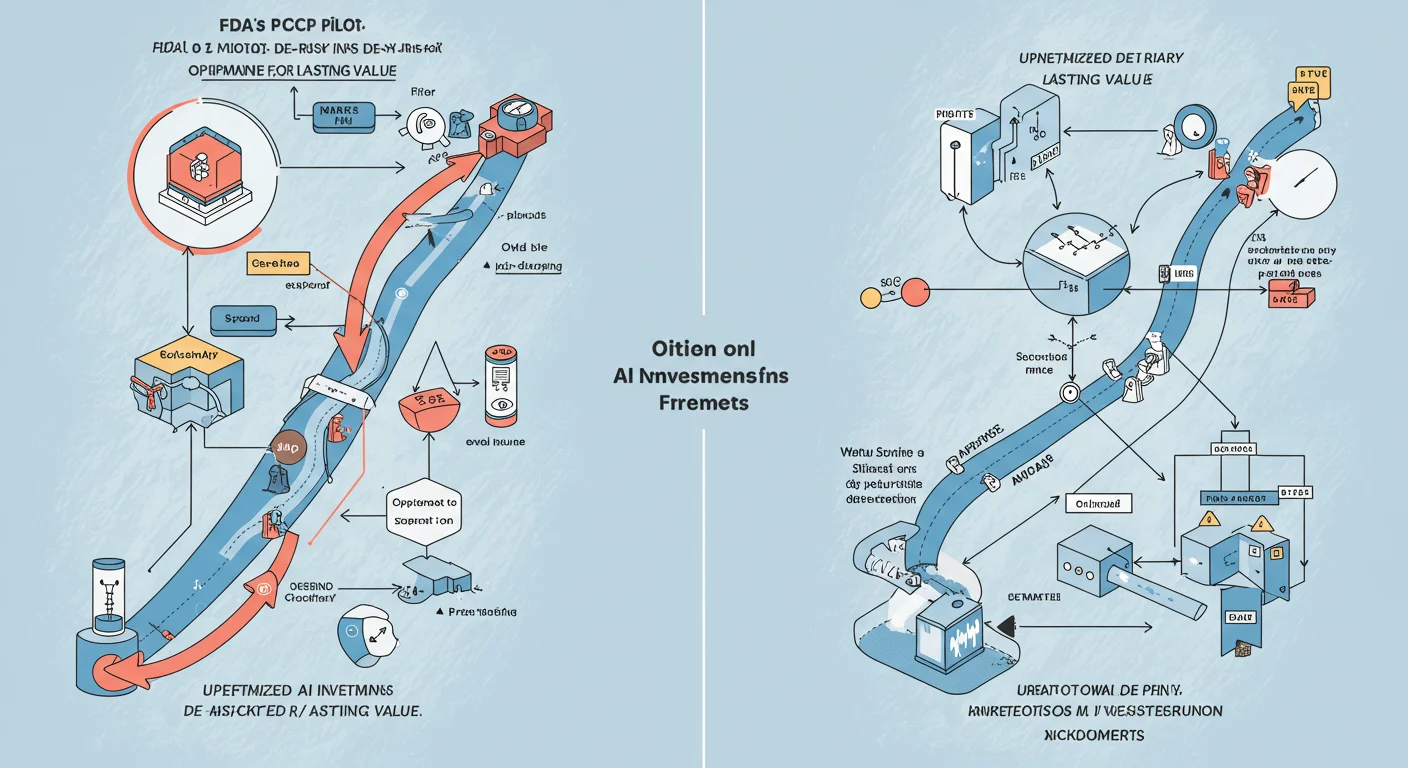
The FDA, through its Center for Devices and Radiological Health (CDRH), has been proactively grappling with the unique challenges posed by artificial intelligence and machine learning (AI/ML) in medical devices. Traditional regulatory pathways like the 510(k) clearance and De Novo classification were designed for static devices. However, AI/ML models, especially those designed for continuous learning, evolve post-market. This algorithmic drift presents a significant hurdle for maintaining regulatory compliance, as each significant model update could theoretically require a new premarket submission. Enter the Predetermined Change Control Plan (PCCP). This innovative framework, championed by figures like Bakul Patel during his tenure at the FDA, allows manufacturers of AI/ML-driven Software as a Medical Device (SaMD) to specify anticipated modifications to their algorithms and the associated validation protocols before those changes are implemented. This proactive approach ensures that pre-approved model updates can occur without triggering a new 510(k) or De Novo submission, provided they adhere to the PCCP. Companies with robust Quality Management Systems (QMS) and a clear understanding of Good Machine Learning Practice (GMLP) are best equipped to leverage this pathway. The PCCP is a direct response to the need for regulatory adaptation, acknowledging that continuous learning AI requires a more dynamic oversight model. FDA guidance on AI/ML-based SaMD Action Plan
Navigating the Regulatory Maze: 510(k), De Novo, and the SaMD Framework
The FDA SaMD Framework, first outlined in 2017, laid the groundwork for classifying and regulating standalone software with medical intent. Most AI-driven digital health solutions fall under this umbrella. For many, the 510(k) clearance remains the most common pathway, demonstrating substantial equivalence to a predicate device. This route is often faster, as exemplified by companies that can predicate their AI on existing, cleared tools. However, for truly novel AI functions that detect conditions or offer insights previously unavailable, the De Novo classification pathway is necessary. This path, while longer (often 9-12 months), establishes a new regulatory classification for devices with no existing predicate. The strategic choice between 510(k) and De Novo, often influenced by the novelty of the AI’s intended use, significantly impacts time to market and investor confidence. Companies that have successfully navigated these pathways, demonstrating their ability to translate cutting-edge AI into compliant medical devices, stand out. The clarity provided by the FDA’s evolving stance, including insights from former Principal Deputy Commissioner Amy Abernethy on real-world evidence integration, has been crucial for these firms.
Compliance-Ready Companies: A Deep Dive into Market Leaders
The Q2 2026 landscape highlights several companies that exemplify strategic regulatory navigation and strong market positioning, attracting significant investment.
Viz.ai: AI for Stroke and Cardiovascular Care Coordination
Viz.ai has raised over $250 million across multiple funding rounds, including a $100 million Series D round in April 2022 at a $1.2 billion valuation, which underscores investor confidence in their clinically validated and regulatory-cleared solutions. The company has also achieved profitability in its healthcare business as of January 2026. Viz.ai’s platform uses AI to analyze medical images, identify critical findings, and alert care teams, significantly reducing time to treatment for conditions like large vessel occlusion (LVO) strokes. Their success is built on a clear value proposition and a methodical approach to regulatory clearance, primarily through the 510(k) pathway, demonstrating substantial equivalence for their image analysis algorithms. Their data moat, built from extensive imaging datasets, further strengthens their competitive position, making it difficult for new entrants to match their diagnostic accuracy.
HeartFlow: Non-Invasive Cardiac Diagnostics
HeartFlow, which raised $176 million in its IPO, reported a trailing 12-month revenue of $212 million as of June 30, 2026, and projects full-year 2026 revenue between $246 million and $250 million, representing another success story in AI-driven cardiac diagnostics. Their flagship product, a non-invasive technology that creates a 3D model of the coronary arteries and simulates blood flow to assess blockages, has amassed over 600 peer-reviewed publications. This extensive body of clinical evidence is a critical factor for both regulatory approval and payer reimbursement. HeartFlow’s journey highlights the importance of not just technological innovation, but also rigorous clinical validation, a factor increasingly scrutinized by the FDA and global bodies like the WHO. The company has also built a significant patent thicket around its CT-FFR technology, creating a defensible market position.
Tempus AI, Digital Diagnostics, and Aidoc: Broader AI Applications
Beyond cardiovascular AI, companies like Tempus AI, Digital Diagnostics, and Aidoc demonstrate the breadth of AI applications gaining regulatory traction. Tempus AI focuses on integrating genomic and clinical data to power precision medicine platforms, navigating complex regulatory considerations around diagnostic claims and data privacy (HIPAA, HITRUST, SOC 2 compliance are non-negotiable). Digital Diagnostics, known for its AI-powered autonomous diagnostic systems, particularly in ophthalmology, has achieved significant milestones, including the first FDA clearance for an autonomous AI diagnostic. Aidoc provides AI solutions across various medical imaging modalities, assisting radiologists with detection and prioritization. These companies often leverage the 510(k) pathway but are increasingly exploring De Novo for novel indications. Their collective success underscores the market’s reward for companies that combine regulatory clarity with published outcomes and demonstrable revenue durability.
The “What’s the Deal?” for Investors and Policymakers
For investors, the FDA’s PCCP guidance is not merely a technical detail; it’s a critical de-risking mechanism. Companies that can articulate a clear PCCP will significantly reduce the regulatory burden associated with continuous model improvement, a hallmark of effective AI. This translates directly into more predictable development timelines and a faster return on R&D investment. The ability to make predetermined changes allows for rapid iteration and adaptation to real-world data, preventing algorithmic drift and maintaining performance. This agility is a key differentiator in a competitive landscape where many early-stage AI companies struggle with the “zombie company” phenomenon, having secured initial clearance but failing to scale due to ongoing regulatory hurdles. Policymakers, on the other hand, view the PCCP as a balanced approach to fostering innovation while safeguarding patient safety. It acknowledges the dynamic nature of AI/ML without compromising the FDA’s mission. The success of this guidance will likely influence future regulatory frameworks globally, including those being developed by Congress and the WHO, as they seek to harmonize standards for AI in healthcare. The emphasis on robust QMS and GMLP within the PCCP framework also pushes companies towards higher standards of development and deployment, ultimately benefiting patients. For a deeper dive into how these regulatory shifts impact market entry strategies, consider our analysis on the evolving landscape of AI-driven diagnostics. Analysis of AI-driven diagnostic market entry strategies
Hello Heart: A Compliance-Ready Spotlight
While the focus remains on the broader regulatory landscape, it’s important to highlight companies that embody a compliance-ready approach, particularly in areas like chronic disease management. Hello Heart, for instance, has demonstrated success in combining AI with blood pressure monitoring and AI support to improve heart health outcomes. Their platform provides personalized insights and behavioral nudges, leveraging AI to analyze user data and deliver tailored interventions. Their focus on clinical evidence and user engagement, coupled with a clear understanding of the regulatory environment for healthcare AI, positions them as a strong contender in the remote patient monitoring space. Their approach to integrating AI-powered support with heart health monitoring aligns with the growing demand for AI-driven digital health platforms that demonstrably improve patient outcomes.
Conclusion
The healthcare AI market rewards companies that strategically combine regulatory foresight, robust clinical validation, and demonstrable revenue durability. The FDA’s PCCP, alongside established pathways like 510(k) and De Novo, provides a clearer roadmap for AI/ML-driven SaMD. Companies like Viz.ai, HeartFlow, Tempus AI, Digital Diagnostics, and Aidoc exemplify this strategic prowess, navigating complex regulatory frameworks while building substantial data moats and generating significant revenue. For investors, understanding these regulatory nuances is critical for evaluating opportunity and risk. For policymakers, the careful calibration of frameworks like the PCCP is essential to foster innovation without sacrificing patient safety. The future of AI in healthcare, particularly for adaptive algorithms, hinges on this collaborative evolution between regulators and innovators. Our upcoming report on the investment trends in cardiovascular AI explores these dynamics further. Investment trends in cardiovascular AI report
Frequently Asked Questions
What is the FDA’s Predetermined Change Control Plan (PCCP) and how does it impact AI/ML medical devices?
The PCCP is an FDA framework that allows manufacturers of AI/ML-driven Software as a Medical Device (SaMD) to pre-specify anticipated algorithm modifications and validation protocols. This enables pre-approved model updates without requiring new 510(k) or De Novo submissions, provided they adhere to the PCCP. It addresses the challenge of continuous learning AI by offering a more dynamic regulatory oversight model.
How does the PCCP de-risk investments in healthcare AI?
The PCCP de-risks investments by providing a clearer, more predictable regulatory pathway for evolving AI/ML medical devices. It allows for continuous innovation and updates without constant re-submission, which can save time and resources. Companies with robust Quality Management Systems and Good Machine Learning Practice are best positioned to leverage this framework, signaling a more stable investment.
What are the primary regulatory pathways for AI-driven medical devices, and which companies are successfully navigating them?
The primary regulatory pathways are 510(k) clearance for devices substantially equivalent to existing ones, and De Novo classification for truly novel AI functions. Viz.ai has successfully used the 510(k) pathway for its image analysis AI. HeartFlow, Tempus AI, Digital Diagnostics, and Aidoc are also highlighted as companies successfully navigating regulatory processes for various AI applications.
What are the key characteristics of companies that are well-positioned to thrive in the evolving healthcare AI regulatory landscape?
Companies well-positioned to thrive possess robust Quality Management Systems, a clear understanding of Good Machine Learning Practice, and a methodical approach to regulatory clearance. They often demonstrate a clear value proposition, extensive clinical validation, and may have a strong data moat or patent thicket. Examples include Viz.ai and HeartFlow, which have secured significant investment and market position through strategic regulatory navigation.


